This is What (Minor) Success Looks Like!

I think most educators know that passive learning is the best way to decrease retention of information. Creating opportunities for students to interact with content provides meaningful gains in their ability to retain information in long-term memory. We provide our students with faculty-created video content to view as pre-work before they come to active learning activities. These videos are uploaded to our lecture capture system (Echo360) along with any live lectures that are recorded. 

I wanted to share a quick story of how embedding interactive polling in our videos has made a significant and positive increase in views at University of Illinois College of Medicine. These first-year medical students are just about to take their final exam for this course so we won’t know quite yet if the embedding of interactive polling in previously passive video content will help improve scores this spring. 

In the spring 2022 image, you can see video views top out around 250 for some videos (and quite low for others). In the spring 2023 image, notice the video views top out around 400! The blue indicates video views and the green indicates interaction with embedded polling, which was nonexistent in 2022. Note, we did not insert polling in every pre-recorded video. For this academic year, we were able to do this for about 15 pre-recorded videos. I’m happy with the progress and look forward to more successes in future block courses!
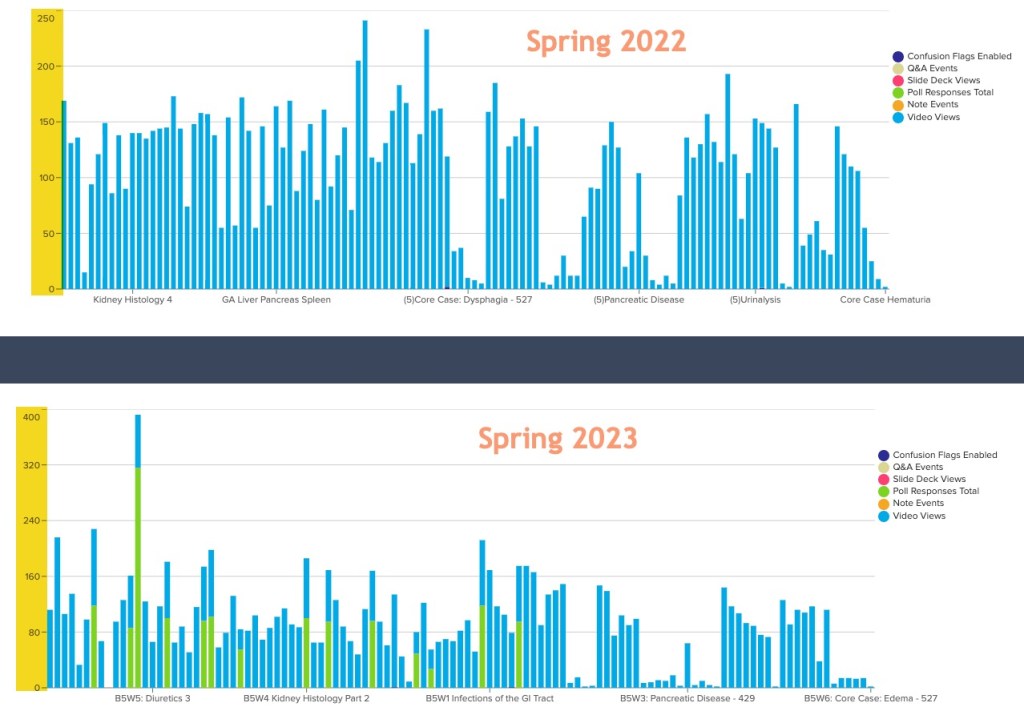
Bar charts showing the difference in video views and interactivity from spring 2022 to spring 2023

When we have embedded polling in these types of videos for other courses, the feedback from students is universally positive. Some examples of feedback from students on evaluations: 

“I like how the video pauses and gives you the chance to click on an answer. All independent learning videos should incorporate that feature.”

“The summary tables after each video are helpful! I like the interactive questions! I would like that to be incorporated into more independent learnings.”

“I’m loving how interactive this lecture is. This is really cool.”

Feedback from instructors: 
“The process of adding interactive questions in videos was intuitive and quick.”
Gamification in Medical Education

At the University of Illinois College of Medicine (UICOM), we have been exploring ways to liven up our educational sessions. With the advent of a new curriculum that has significantly fewer didactic sessions, and increased preparatory work by students leaves some holes to fill for face-to-face activities. One such example of gamification that we have employed recently is Kahoot!

Here is an example of Dr. Mahesh Patel using Kahoot! to encourage more interaction, and it proved to be a success.

We only use it sparingly, which I believe is why it is successful. Dr. Patel and I have worked together to figure out the best way to introduce it and when – the most success we have had with it is at the end of a busy week during a core case session. The students (and us!) are wiped out and it helps end the week on a fun note. We already use Poll Everywhere (probably too much), so this is a nice break from the ordinary.

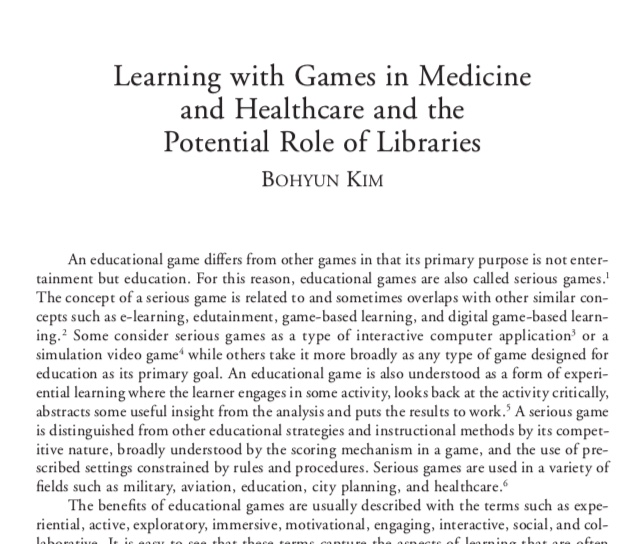
Frontpiece image of an article by Bohyun Kim for an article she wrote called Learning with Games in Medicine and Healthcare and the Potential Role of Libraries
Kim, B. (2015). Understanding gamification. Library Technology Reports, 51(2).


There is a growing number of scholarly articles in the medical education literature about gamification, and I predict that will just increase. A wonderful colleague of mine, Bohyun Kim, has published extensively on this topic, from the perspective of the librarian educator.


Here are some peer-reviewed citations to check out:

Hicks, G. L. (2015). Gamification: Fuelish or foolish? Journal of Thoracic and Cardiovascular Surgery, 150(5), 1059-1060.

Kim, B. (2015). Understanding gamification. Library Technology Reports, 51(2).*

McCoy, L., Lewis, J. H., & Dalton, D. (2016). Gamification and multimedia for medical education: A landscape review. Journal of the American Osteopathic Association, 116(1), 22-34. doi: 10.7556/jaoa.2016.003

McDougall, A. (2018). When I say ….. gamification. Medical Education, 52, 469-470.

*she wrote pieces for the entire report