I think most educators know that passive learning is the best way to decrease retention of information. Creating opportunities for students to interact with content provides meaningful gains in their ability to retain information in long-term memory. We provide our students with faculty-created video content to view as pre-work before they come to active learning activities. These videos are uploaded to our lecture capture system (Echo360) along with any live lectures that are recorded.
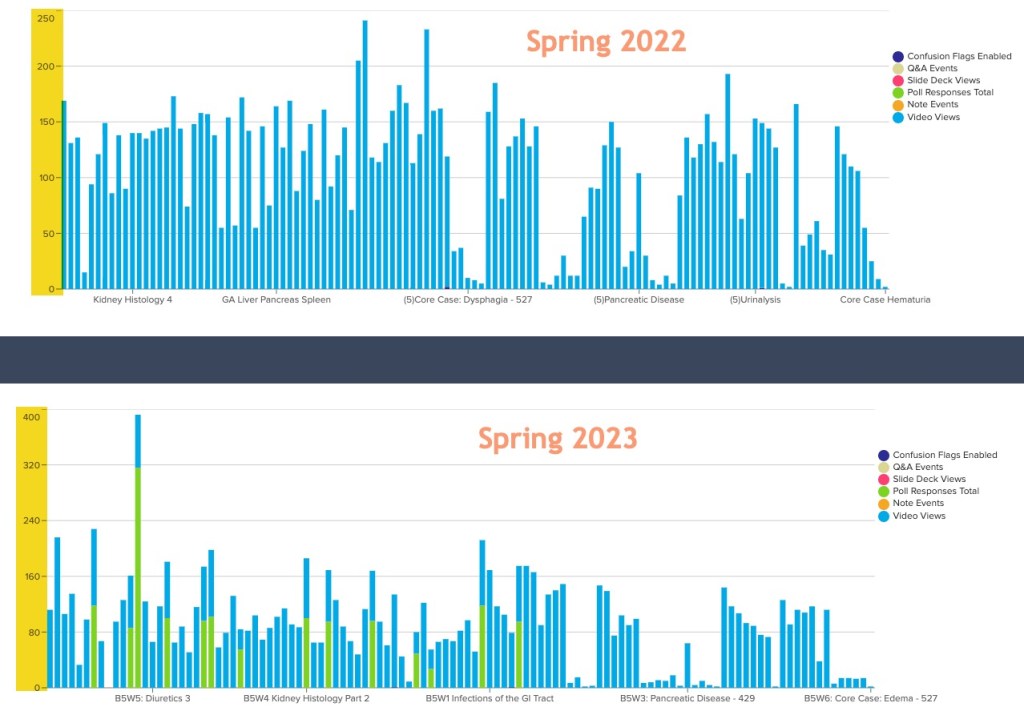
I wanted to share a quick story of how embedding interactive polling in our videos has made a significant and positive increase in views at University of Illinois College of Medicine. These first-year medical students are just about to take their final exam for this course so we won’t know quite yet if the embedding of interactive polling in previously passive video content will help improve scores this spring.
In the spring 2022 image, you can see video views top out around 250 for some videos (and quite low for others). In the spring 2023 image, notice the video views top out around 400! The blue indicates video views and the green indicates interaction with embedded polling, which was nonexistent in 2022. Note, we did not insert polling in every pre-recorded video. For this academic year, we were able to do this for about 15 pre-recorded videos. I’m happy with the progress and look forward to more successes in future block courses!
When we have embedded polling in these types of videos for other courses, the feedback from students is universally positive. Some examples of feedback from students on evaluations:
“I like how the video pauses and gives you the chance to click on an answer. All independent learning videos should incorporate that feature.”
“The summary tables after each video are helpful! I like the interactive questions! I would like that to be incorporated into more independent learnings.”
“I’m loving how interactive this lecture is. This is really cool.”
Feedback from instructors: “The process of adding interactive questions in videos was intuitive and quick.”
ChatGPT has been in the news since at least November 2022. Many of you are likely familiar with it by now or have at least heard of it. In terms of artificial intelligence (AI), it is not the only player on the block. There has been a lot of hand-wringing from educators around the potential (and currently seen) impact of ChatGPT. In January 2023, New York state banned it in K-12. There have been a plethora of experts writing about it and hosting panel discussions.
The Rise of ChatGPT: How to work with and around it
From the description: “Watch an exciting episode of our Liquid Margins series, “Liquid Margins 38: The rise of ChatGPT and how to work with and around it”. In this episode, we discuss the implications of ChatGPT in higher education and how faculty are approaching this evolving new technology. Faculty guests include Joel Gladd of College of Western Idaho, Kat King of Diablo Valley College, Dr. Nicholas LoLordo of the University of Oklahoma, Rachel Elliott Rigolino of SUNY, together with our very own Jeremy Dean, VP of Education of Hypothesis.”
Faculty across the world have expressed concern about how AI might disrupt educational processes with worry that even their jobs might be at risk due to AI. I do not believe AI will be the deathknell for humans to continue to be educators. It will require us to think outside the lines for how to take advantage of it.
AI can assist, but there would always be a need for instructional professionals because AI won’t know the students or the faculty on campus. AI won’t know what works best for the local learning community. AI won’t know the craft of instruction or how a particular instructor helps students succeed through instructional practices and personal engagement/feedback. Context is very important and necessary. AI can learn about the context, but never experience the context or the engagement between learners, content, and instructor.
Michael Porterfield, Ph.D., Educational Technology Manager, McKendree University EDUCAUSE, April 6, 2023 – Instructional Design Community
Continue on, Dear Reader
Read on to discover more AI tools out there and what they can provide. Who knows – maybe you’ll find one of them useful for your own purposes. These are some AI tools that I have found interesting lately.
Evidence Hunt is an interesting resource which enables you to pose questions about clinical evidence to PubMed abstracts.
I posed the following question to it: In patients with osteoarthritis of the hip, is water therapy more effective than land-based exercise in restoring range-of-motion?
The response I got back from the AI tool: A comparison of land-based and water-based rehabilitation programs following total knee replacement surgery showed comparable outcomes in terms of range of motion in both groups (pmid: 19177536). However, there is no direct evidence comparing water therapy to land-based exercise specifically for hip osteoarthritis.
The query string it used to search PubMed:
((\”osteoarthritis\” OR \”hip osteoarthritis\”) AND (\”water therapy\” OR \”aquatic therapy\”) AND (\”range of motion\” OR \”ROM\” OR \”flexibility\”)) OR ((\”osteoarthritis\” OR \”hip osteoarthritis\”) AND (\”land-based exercise\” OR \”physical therapy\”) AND (\”range of motion\” OR \”ROM\” OR \”flexibility\”)) OR ((\”water therapy\” OR \”aquatic therapy\”) AND (\”hip range of motion\” OR \”hip mobility\” OR \”hip flexibility\”) AND (\”osteoarthritis\” OR \”hip osteoarthritis\”)) OR ((\”land-based exercise\” OR \”physical therapy\”) AND (\”hip range of motion\” OR \”hip mobility\” OR \”hip flexibility\”) AND (\”osteoarthritis\” OR \”hip osteoarthritis\”)) OR ((\”physical therapy\” OR \”exercise therapy\”) AND (\”water therapy\” OR \”land-based exercise\”) AND (\”hip range of motion\” OR \”hip mobility\” OR \”hip flexibility\”) AND (\”osteoarthritis\” OR \”hip osteoarthritis\”))
This is the main scholarly article in PubMed it pointed to:
As I am not a subject expert in this area, I cannot verify the result is relevant. The About section of the website says it is scanning the text of over 35 million PubMed articles. Try it yourself. As of April 2023, you must include your email address when you search.
Galileo AI
Galileo AI creates delightful, editable user interface (UI) designs from a simple text description. It empowers you to design faster than ever. It is currently in beta and you have to request early access. It sounds promising and not just for web designers. It will be interesting to see it in action when it’s available.
SlidesAI
SlidesAI is an AI tool to create ‘presentation slides in minutes.’ As of April 2023, it works with Google Slides and ‘coming soon’ to PowerPoint. You have to install the add-on to Google Slides for it to work.
I tried this out by using a description of an upcoming conference presentation.
Here is the description I gave it to produce slides:
“Health sciences scholarship acknowledges the need for widespread cultural transformation championing inclusion, diversity, equity, and accessibility (IDEA) across all levels of medical education and health care (Humphrey, Levinson, Nivet, and Schoenbaum, 2020). As members of educational technology teams, we are uniquely positioned to engage with a broad range of the medical education community, including internal organizations, curricular development, audio visual and pedagogical technology support, and facilities. In this session, four schools share their approaches to applying IDEA principles within their organizational culture and through implementations of educational technology in support of medical schools and inclusive patient care, including topics of belonging for women in technology, DEI curriculum, library databases, faculty development, and accessible learning spaces and technologies.”
Synthesis.io is a platform to create ‘professional videos in minutes.’ Similar to Wellsaid Labs, this one brings video creation using AI to the next level. You add your own text, select a ‘talking head’ and see what it produces. Here are some of the features. Synthesia uses your text to create very lifelike avatars who speak your words.
The days of computer-generated voiceovers that sound like a computer speaking are coming to a quick close.
Not going to be too critical, but I did notice a typo on their website. Should I tell them? Hmmm. Maybe I’ll have my avatar tell them using an AI-generated voice.
Wellsaid Labs
Wellsaid Labs is an AI voice platform. It helps you to create voiceovers using text-to-speech AI generated voices with different delivery styles, pitch, speed, etc.
Here are some examples for creating AI voiceovers for video production. This might be a useful tool if you need to record video but don’t want to spend the time recording your voice. As long as you have a decent script, this tool might work for you.
So there you go – some of the AI tools I’ve been looking at lately. There are so many coming out of the proverbial woodwork, it’s more difficult to keep up with them all.
This is the culmination of a study based on a cross-sectional survey sent to various online environments such as the DR-ED listserv. The goal was to reach people in medical education who also have a hand in instructional design. One major limitation is that we did not leave the survey open long enough to gain an even larger sample. Read the article and let me know what you think in the comments!
Today I gave a presentation for the faculty & fellows in the Division of Pulmonary, Critical Care, Sleep and Allergy in the Department of Medicine. I met with Dr. Christie Brillante a month or so ago because she had heard about some of the presentations I have given here in the college of medicine. I was slightly apprehensive to do this one, because she wanted me to talk about facilitation skills for people who do ‘micro-consults’ which could also be considered bedside consultations, ‘mini-consults’ which are slightly longer, and their regularly scheduled noon conferences.
EEK.
I was nervous because I have never been on rounds before so I did not really feel like I am an appropriate person to speak to it, and I made sure Dr. Brillante knew this. So, I went in, and delivered my presentation. It was a bit difficult as usual getting some of the attendees to speak up, but I persevered. What I can talk about is multimedia design. I shared some of our best practices in the college in regards to PowerPoint slide deck design like choice of color, font, amount of content, and taking into consideration some cognitive issues. In particular, I talked about some of Richard Mayer’s 12 Principles of Multimedia Learning. By the way, this document came from the University of Hartford, Faculty Center for Learning development. I focused on these three:
Coherence Principle – People learn better when extraneous words, pictures and sounds are excluded rather than included.
Signaling Principle – People learn better when cues that highlight the organization of the essential material are added.
Spatial contiguity Principle – People learn better when corresponding words and pictures are presented near rather than far from each other on the page or screen.
There is a ‘Last Page’ in Academic Medicine journal coming out soon and it was right on target with this topic. It’s called “‘We’re Not Too Busy’: Teaching with Time Constraints on Rounds” by Flint Y. Wang, MD, and Jennifer R. Kogan, MD at Perleman School of Medicine at the University of Pennsylvania. I have seen an advance copy of this one and it’s definitely worth looking at when the journal issue comes out.
Here is my presentation via SlideShare. Let me know what you think. I feel like the presentation went well. One of the attendees offered to bring me on consults and I jumped at the chance. It will give me some insight into an area of content facilitation that I am lacking expertise.
This was a comment to an article I read this morning called The Quest for Great Instructional Designers. Another commenter on this article made some strong points that I identify with:
The biggest problem, from personal experience as an instructional designer myself, is many institutions don’t have a clear definition, or simply don’t understand, of what instructional design (ID) is and what an instructional designer does. At the end of the day, instructional design is about taking everything we know about teaching/learning (systematically) and creating environments conducive to learning. ID postings that are seeking individuals to do high-end multimedia production, creating instructional media for faculty, and/or creating online courses for faculty is not instructional design. In cases like this, institutions are really asking for multimedia developers and course developers. Familiarity with contemporary learning management systems, in my mind, will always be an expectation for an instructional design position at least in higher education. With regards to knowing specific software applications, most ID graduate programs don’t offer much in terms of software skills. More focus tends to be on instructional design theory/practices, research, and andragogy. The software is one of those things that most instructional designers are left to learn on their own. By the way my MA and Ph.D. are in Instructional Technology/Design. Thanks for sharing your perspective.
The bold above is mine. Most job postings I see regarding instructional designer or technologist openings want someone who can do it all. So, great, you find a person who matches ALL of your requirements. They can do faculty development, understand how to use learning management systems, can program in multiple languages, have excellent video / audio / multimedia skills. First, is that what your organization needs, and second, you hire this one person who can do ‘it all,’ and a year later they leave. Back to square one. There is no I in TEAM!! You need a team of people to be ‘architects of learning.’
Keep an eye out for a research article hopefully later this year, which addresses this very issue. Dr. Linda Love, Dr. Faye Haggar and I did a survey on instructional designers in medical education and the results we got back address what is in this article and the comments. We are in the middle of writing up the results and hope to have it published within the next 6 months.
What is your perspective on what makes a great instructional designer?

 Max Anderson, PhD